
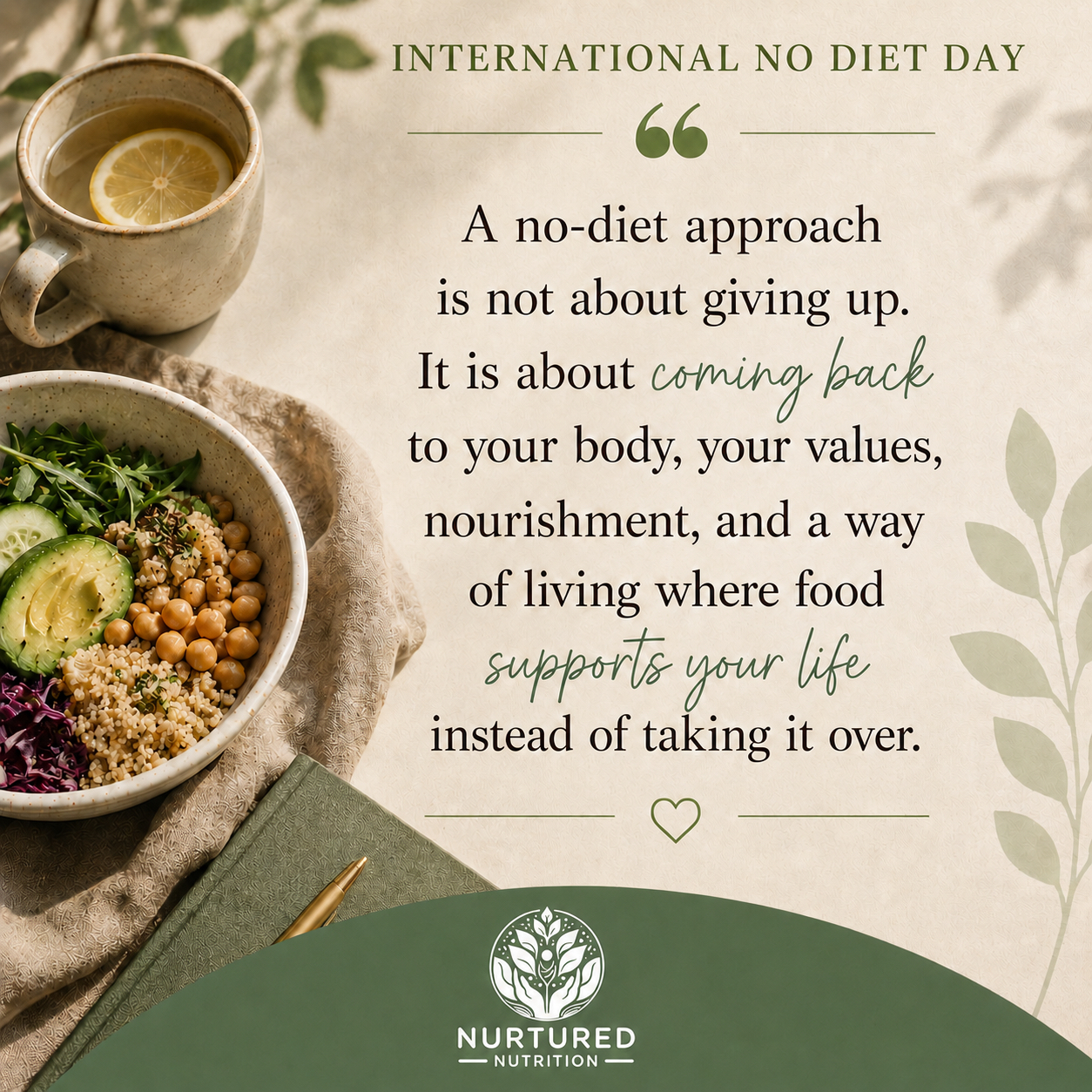
International No Diet Day: What “No Diet” Really Means in a Culture Obsessed With Control
It is not always a strict meal plan, a calorie goal, a detox, or a “summer body” challenge. It hides inside conversations about being “good,” “getting back on track,” eating clean, reducing inflammation, managing appetite, or finally “taking control.” This is where things get complicated, because wanting to feel better in your body is not wrong. Wanting more energy, better digestion, improved labs, or a calmer relationship with food are all valid goals. But sometimes, the pursuit of health quietly turns into another way to monitor, shrink, criticize, or disconnect from the body.
Diet Culture Has Become Harder to Spot
Years ago, diet culture was easier to name. It looked like low-fat foods, weight-loss commercials, celebrity diets, and magazine covers promising a new body in 30 days. Now, it is more subtle. It can sound thoughtful, scientific, and responsible.
That does not mean every health behavior is diet culture. Nutrition, medical care, movement, and eating patterns can all play a meaningful role in digestion, energy, mood, labs, and overall well-being.
The question is not only, “Is this behavior healthy?” A better question might be, “Is this behavior helping me build a more peaceful and connected relationship with food and my body?” A behavior can appear healthy on the surface while still causing harm internally.
The Same Behavior Can Mean Two Very Different Things
One of the hardest parts of healing your relationship with food is that the behavior itself does not always tell the full story. For one person, eating breakfast might be a simple act of nourishment. For another, it might be a major step in eating disorder recovery. Adding more protein may help one person feel satisfied and steady, while for someone else, it may become another rigid rule they feel anxious about breaking.
The same is true for movement, weighing, meal planning, tracking, or making changes to food choices. Going to the gym may feel grounding and enjoyable for one person, while for another person, it may be a way to compensate for what they ate. Seeing a number on the scale may feel like neutral information for someone with one history, while for someone with another history, it may determine their mood, food choices, and sense of worth for the rest of the day.
This is why nutrition work cannot be reduced to a list of “good” and “bad” choices. Context, history, thoughts, emotions, and patterns all matter. A choice is not automatically helpful just because it looks “healthy,” and it is not automatically wrong just because diet culture has used it before. The deeper work is learning how to tell the difference.
A Better Question Than “Is This a Diet?”
At Nurtured Nutrition, we often come back to this question: “Is this helping me care for my body, or is this helping me control my body?” That question can be uncomfortable.
Care tends to create more steadiness, flexibility, and trust. Control tends to create more fear, rigidity, and disconnection. A caring choice usually leaves room for real life, while a controlling pattern often depends on perfect conditions. A supportive behavior helps you participate more fully in your life, while a restrictive or fear-based behavior often makes your world smaller.
This does not mean the answer will always be obvious. Sometimes it takes time to understand what is really driving a behavior. Support from a dietitian, therapist, physician, or care team can help you sort through the gray areas. But the question itself matters because it creates space between an automatic pattern and the next choice.
The GLP-1 Conversation Has Made This Even More Complicated
It is impossible to talk about diet culture right now without naming the current cultural conversation around GLP-1 medications. For some people, these medications may be part of medical care. For others, the constant discussion around appetite suppression, weight loss, body size, and “food noise” may feel incredibly triggering.
Many people are not just making personal decisions in private. They are trying to recover, heal, or build body trust while being surrounded by conversations about who is taking what, who is losing weight, who looks different, and what appetite “should” feel like. That can be exhausting.
This is not about labeling every medication or medical decision as good or bad. That would be too simplistic. It is about recognizing that we are in a cultural moment where body control is being talked about constantly. When the outside noise gets louder, internal clarity becomes even more important.
No Diet Does Not Mean “No Nutrition”
One common misunderstanding about anti-diet work is that it means nutrition no longer matters. That is not what we believe.
No Diet Day is not about ignoring your health, pretending food has no impact on the body, or rejecting medical nutrition therapy, structure, planning, and supportive behavior change. It is about rejecting the idea that shame is required for health. It is about challenging the belief that your body needs to be fixed before you can care for it. It is about building a relationship with food that is flexible enough to support your actual life.
Nutrition can be supportive without becoming obsessive. Structure can be helpful without becoming rigid. Movement can promote health without becoming punitive. Food choices can matter without turning into a moral report card. That is the space many people are looking for: not another extreme, not another set of rules, and not another plan that works for three weeks and then collapses, but a steadier way of caring for themselves.
What Food Freedom Often Looks Like in Real Life
Food freedom is not always dramatic. Often, it is quiet. It may look like eating breakfast even when part of you wants to skip it, ordering the meal you actually want instead of the one that feels safest, keeping snacks in the house without feeling like you failed, or noticing fullness without panic.
It may also look like resting without needing to “earn it,” eating more on a hungry day without turning it into a problem, having a hard body image day and still feeding yourself, or going out to eat and letting the meal be a meal rather than a moral event. These moments may seem small, but they are often the places where trust is rebuilt.
Coming Back to Yourself
If this article brought something up for you, here are a few places to begin. You do not need to overhaul your entire relationship with food today. Start with one small area where diet culture may still be influencing your choices.
1. Notice the language you use around food
Pay attention to the words you use before and after eating. Words like “good,” “bad,” “clean,” “cheat,” “earned,” or “ruined” can quietly reinforce the idea that food choices determine your worth. Try replacing judgment-based language with more neutral observations, such as “This meal was satisfying,” “I’m still hungry,” “That did not sit well with me,” or “I enjoyed that.”
2. Ask: “Is this care or control?”
When you are considering a food, movement, or body-related choice, pause and ask yourself whether the behavior is coming from care or control. Care usually leaves room for flexibility and real life. Control often creates urgency, fear, or pressure to do things perfectly.
3. Identify one rule that feels rigid
Choose one food rule you notice yourself following, even when it no longer feels helpful. It might be a rule about when you are “allowed” to eat, what foods can be kept in the house, how much exercise is “enough,” or what counts as a “good” day. You do not have to challenge it all at once. Start by simply naming it.
4. Practice one act of nourishment without compensation
Pick one small way to nourish yourself this week without trying to balance it out, earn it, or make up for it later. This could mean eating breakfast, adding a snack, choosing a satisfying lunch, resting when tired, or allowing a meal to be imperfect without turning it into a problem.
5. Curate the noise around you
Notice which accounts, conversations, apps, or habits leave you feeling more anxious, critical, or disconnected from your body. Consider unfollowing, muting, deleting, or stepping back from anything that repeatedly pulls you into comparison or body monitoring.
6. Get support if food feels hard to navigate alone
If your relationship with food feels confusing, rigid, chaotic, or emotionally exhausting, you do not have to sort through it by yourself. Working with a dietitian can help you understand your patterns, rebuild trust with your body, and create a way of eating that supports both your health and your life.
Maybe International No Diet Day is not just about saying “no” to diets. Maybe it is about asking better questions. Where has diet culture taught you to distrust yourself? Where have you confused control with care? Has the pursuit of health started to make your life feel smaller? What helps you feel more grounded in your body? What would it look like to care for yourself without making your body the enemy?
You do not need perfect answers to those questions, but asking them matters. Your relationship with food is not supposed to be a lifelong battle. Your body is not supposed to be a project you are constantly trying to correct. Health is not supposed to require disconnection from yourself.
Enjoy a Life Where Every Meal is a Celebration, Not a Challenge.
We are here to guide you on a journey to a healthier, happier you. Take the first step towards a lifetime of wellness and schedule your initial consultation today and let our dietitians help you make every meal a joyful experience.